
Published June 10, 2026 — by the ERP Control team (Globasoft) · 6 min read
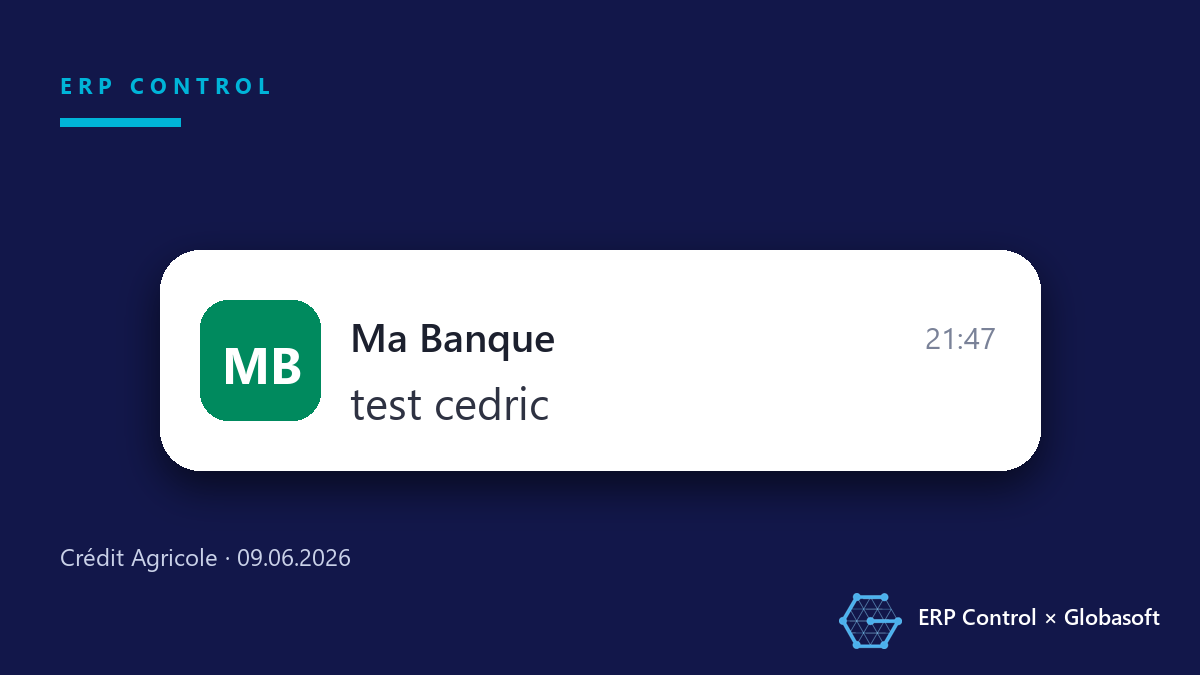
Not a hacker. Just a test.
In short: on June 9, 2026, an internal “test cedric” notification from Crédit Agricole was mistakenly pushed to Ma Banque customers, causing an unintentional denial of service. Beyond the anecdote, it is a textbook case: a test element crossing the test → production boundary. The same risk exists in any enterprise system — including an ERP such as IFS Cloud — and it is prevented by environment governance.
The incident in brief
On June 9, 2026, many Crédit Agricole customers received a push notification titled “test cedric” on the Ma Banque app: two words, no context, no action required. Everything points to a technical verification message — the kind sent to check the push pipeline before a real release — that should have stayed in an internal staging environment, but ended up broadcast to a large volume of customers.
The most telling part is not the notification itself, but its domino effect: intrigued or worried, tens of thousands of users opened the app at the same time. That spike of simultaneous connections acted as an unintentional denial of service: the authentication servers gave way, and account access was disrupted.
Note: as of publication, Crédit Agricole has not shared a detailed technical explanation. The above reflects publicly available information.
The real problem: the boundary between test and production
Reducing this to “someone made a mistake” misses the point. What really happened is the permeability between a test environment and production. Three classic failures combine:
- Insufficient isolation — a staging environment should be incapable, by design, of reaching real customers.
- Uncontrolled promotion — something moved from “test” to “prod” with no safeguard: no validation, no review, no comparison of what actually changes.
- System-scale effect — in production, a small error does not stay small. It meets real scale and triggers disproportionate consequences.
What separates a test from an incident is the environment it runs in.
It doesn’t only happen to consumer banks
Every enterprise system runs with several environments — development, staging, pre-production, production — and any data, configuration or permission can, by mistake, cross the boundary. In the ERP world, and especially IFS Cloud, the “Test Cédric” takes more discreet but just as costly forms:
- Test data promoted to production — dummy accounts, demo amounts ending up in the real database.
- A configuration promoted too early — validated in UAT but moved to PROD without checking the gaps.
- Permissions misaligned across environments — a process working in staging fails in production over a rights gap (the
SE_UNAUTHORIZEDerror is the textbook example). - Production data copied to staging without anonymization — real customer data in a less protected environment: a direct GDPR problem.
How to separate test and production: 3 pillars
1. Truly separate the environments
Separation must be technical, not merely organizational. A staging environment should not be able to act on the real world. On an ERP, that means distinct environments — typically CFG → UAT → TRN → PROD — with partitioned access and data.
2. Control every promotion
No change should cross into production without an explicit validation step. What is promoted? By whom? When? An auditable promotion turns a risky operation into a controlled, reversible move.
3. Compare before promoting
Before promoting, you must see the gap between source and target: which configurations differ, which permissions are not aligned, which data will be affected. You only promote well what you have compared.
What CI/CD teaches us — applied to an ERP
Software solved this fifteen years ago with CI/CD: nothing reaches production without a chain of automated checks and explicit validations. These principles apply just as well to the configuration and data of an ERP, where the “pipeline” is the promotion CFG → UAT → TRN → PROD.
| DEV | → | STAGING | → | PRE-PROD | → | VALIDATION | → | PROD |
The most enlightening principle here is progressive rollout. The incident did not spiral because of the message, but because it hit 100% of users simultaneously. A staged rollout — a few percent first — would have turned a major incident into a minor glitch fixed before it spread.
The role of ERP Control
On IFS Cloud, this is exactly ERP Control’s mission: to give you control over what moves between your environments.
- Compare environments (configuration, permissions) to reveal CFG · UAT · TRN · PROD gaps before any promotion.
- Control and trace promotions of configuration and data (via Excel import/export and the ODATA API).
- Secure test data: quality and GDPR anonymization of non-production environments.
Do you manage IFS Cloud environments and want to be sure of what reaches production? Request a free 2-week POC.
FAQ
What happened with the “Test Cédric” notification?
On June 9, 2026, an internal test notification was mistakenly sent to many Ma Banque customers. The simultaneous rush of users caused an unintentional denial of service.
How can a simple test message take down an app?
Because in production the error meets real scale. Tens of thousands of simultaneous connections can saturate the authentication servers.
How do you prevent a test from reaching production?
Through environment governance: real technical isolation, traced control of every promotion, and comparison of the gaps before promoting.
What is progressive rollout?
Delivering a change in stages — 1%, then 10%, then 100% — so an anomaly is stopped before it reaches everyone.
Sources: Clubic, ActuCrypto (June 9, 2026).